
How Leased Lines Improve Performance for Multi-Site Businesses
Leased lines for multi-site businesses provide a dependable way to connect offices, warehouses and retail outlets so teams can work without interruptions. For small business owners managing several locations, a dedicated circuit can transform branch office internet links and inter-office communication by offering consistent speeds, low latency and a service-level agreement that consumer broadband cannot match.
How leased lines for multi-site businesses improve resilience and speed
When linking multiple locations, the difference between shared broadband and a dedicated connection is predictable performance. Leased lines deliver symmetric bandwidth — upload and download capacities that are the same — which matters for cloud backups, VoIP calls, video meetings and synchronising databases across sites. That predictability reduces the risk of bottlenecks during peak hours and supports multi-site network reliability.
Key performance advantages
- Guaranteed bandwidth and predictable throughput, which prevents one site from slowing the rest.
- Low and stable latency for time-sensitive applications such as VoIP and remote desktop.
- Service-level agreements that include uptime commitments and repair times.
- Symmetrical speeds that help distributed teams upload large files and back up data without delay.
- Scalability options to increase capacity as the business grows or when linking additional locations.
Private WAN leased line or MPLS alternative?
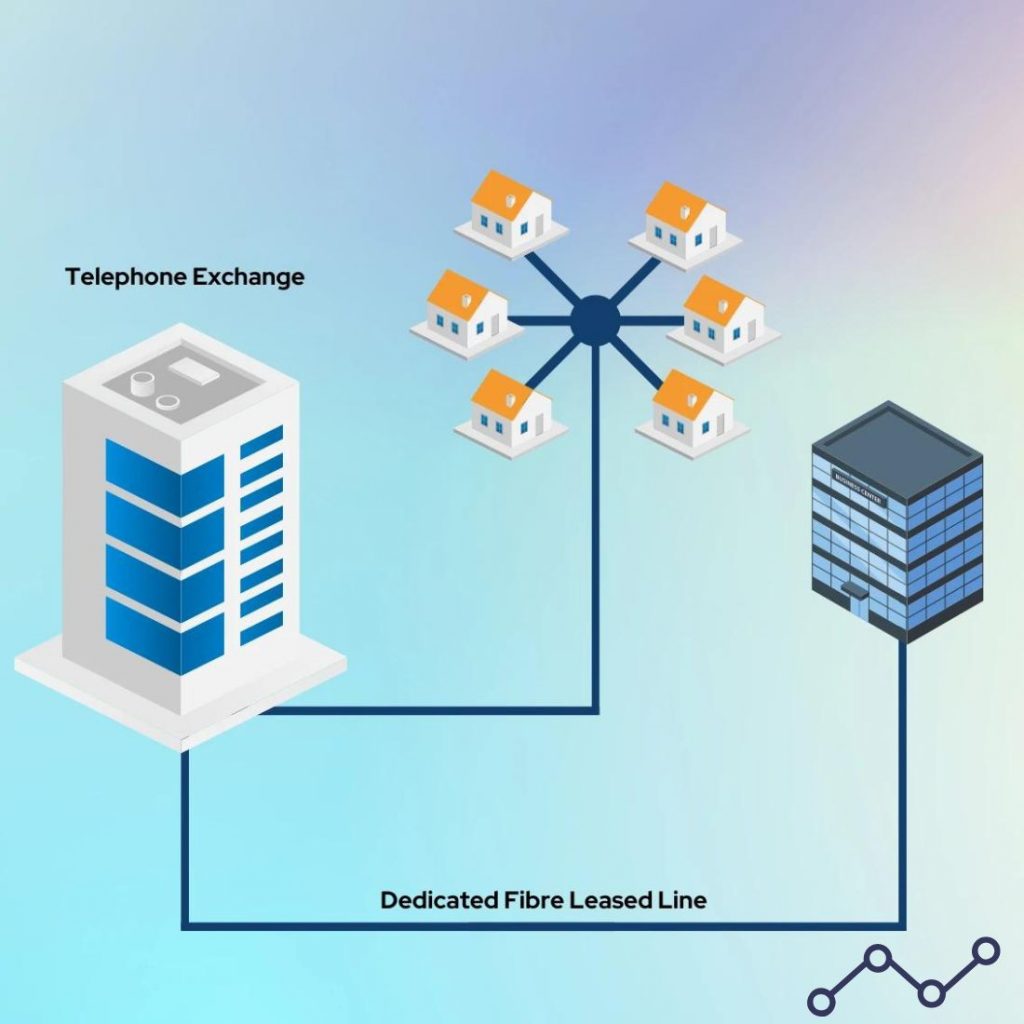
Businesses that need to join many branches often consider a private WAN leased line or an MPLS alternative such as SD‑WAN. A private WAN leased line creates point-to-point links between sites, delivering secure, dedicated capacity. MPLS has been popular for routing traffic with quality-of-service controls, but modern SD‑WAN overlays can use leased lines as primary backhaul while still offering centralised management and application-aware routing.
Choosing between options depends on how critical latency and direct routing are to your operations, whether you require traffic segregation, and how many sites you must connect. For organisations prioritising deterministic performance and simple topologies, a dedicated circuit between sites often proves the most straightforward solution.
Security and reliability considerations
Dedicated connections reduce exposure to the public internet and simplify compliance. A private circuit can be combined with encryption and firewall policies to protect sensitive data in transit. In addition, redundancy should be part of the design: dual circuits or diverse paths minimise downtime from a single point of failure and increase multi-site network reliability.
Deployment and cost factors
Installation times for leased lines are typically longer than consumer broadband because of the need for physical provisioning and testing. Small business owners should factor in lead times, potential civil works for new fibres, and monthly rental costs. Total cost of ownership is balanced by the operational benefits: fewer outages, reduced time spent troubleshooting, and improved productivity across distributed teams.
Practical steps to evaluate a leased line
- Map your sites and identify critical applications that require low latency or guaranteed throughput.
- Decide whether a point-to-point private WAN or a centralised hub-and-spoke model suits your workflow.
- Request detailed SLAs covering latency, jitter, packet loss and mean time to repair.
- Consider redundancy and whether diverse routing or backup broadband is necessary.
- Plan for future growth: ensure contracts or designs allow for bandwidth upgrades without lengthy rework.
Example: Westbridge & Co — a short scenario
Westbridge & Co run a head office and three design studios across two cities. Video conferencing and shared CAD files were frequently interrupted. By installing a private leased line between the head office and each studio and configuring a simple hub-and-spoke topology, they achieved consistent upload speeds for file synchronisation and dramatically reduced call dropouts. The predictable connection allowed their teams to collaborate in real time without repeated transfers or delays.
Operational tips for maximising value
- Prioritise traffic so core business applications receive the necessary resources while less critical services are limited during congestion.
- Monitor performance continuously; SLA monitoring helps verify that the provider meets agreed standards.
- Combine leased lines with secure VPNs or on-premise firewalls to maintain a strong security posture.
- Review contracts regularly to ensure the service still matches business requirements as locations or workloads change.
Leased lines for multi-site businesses are an investment in predictable connectivity. For small firms that rely on steady inter-office communication, dedicated connections reduce interruptions and give IT teams a reliable platform for supporting distributed teams. Well-planned deployment, redundancy and clear SLAs ensure the network keeps pace with operational needs.